| Game Menu |

|
Bigfoot Bonkers is an 2-player (only) maze arcade game released by Meadows Games in 1976. Players move their blocks across the screen to create walls to try to surround their opponents and force them to crash into the walls or any block or obstacle like a 'foot'. This type of game appeared in many variants on many computers and consoles over the years, and was popular on mobile phones like Nokia many years later as one of the default games called "Snake".
Rating: Not rated yet Times Played: 2825 Released: 1976 |
|
Personal Best: N/A
|

|
Using four directional buttons, each player moves their character around leaving a solid line behind them, turning at 90 degree angles. To win, a player must last longer than the opponent before hitting something, with the first person to hit something losing. The game ends after one player gains six wins.
Rating: Not rated yet Times Played: 2525 Released: 1976 |
|
Personal Best: N/A
|
|
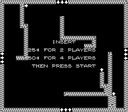
This game was for two or four players only, you must have a live human opponent to play against, or else the other players character will go straight into a wall, making for a very quick and boring game. Each player moves their character around leaving a solid line behind them. All moves are made on an invisible grid, so you can only turn at 90 degree angles. To win you must last longer than your opponents before hitting something. Each player is eliminated when they crash, taking their lines with them.
Rating: Not rated yet Times Played: 2482 Released: 1977 |
|
Personal Best: N/A
|

|
Gobbler is a colorful and zany snake game.
Rating: Not rated yet Times Played: 1638 Released: 1992 |
|
Personal Best: N/A
|

|
HUSTLE is a 1- or 2-player video game which challenges players' reaction time as they attempt to build up a high score. The object of the game is to maneuver a moving arrow into targets which appear randomly on the screen. Each arrow is accompanied by a tail, which can be used to block the opponent from scoring targets.
TARGETS : The targets appear randomly on the playfield. The position of a target, the value of a target, the time a target stays on the screen, and the time before a target appears are all unpredictable : There are never more than two targets on the screen at any time.
To add to the unpredictability, some targets appear with a value of ???. These are mystery targets, and can have a value from -900 points to +900 points. Players go after the mystery targets at their own risk since the only way to determine whether or not a mystery target is positive or negative is to hit the target. Whenever a target is scored, the game pauses while the appropriate player's score is tallied. Two distinctive sounds accompany the scoring, depending on whether the target score is positive or negative. All non-mystery targets (which are all positive), and all mystery targets (which have positive values) are scored with an attention-getting warble sound. All mystery targets which prove to be negative are scored with a distinctive penalty sound.
CRASHES : A crash (accompanied by a loud boom sound) occurs whenever a player hits anything other than a target. The three obstacles a player might hit are one of the screen boundaries, the other player's tail, or his own tail. Whenever a crash occurs, the opponent scores 400 points PLUS all target values on the screen. If any mystery targets are on the screen during a crash, their values are revealed, and they are awarded to the opponent. All mystery targets whose values are revealed as the result of a crash are scored positive for the opponent.
GAME SPEED : The game begins with the players moving at a moderate pace. Every time a target is scored, the pace picks up slightly. After ten targets have been scored without a crash, the pace stays at a maximum rate. Whenever a crash occurs, the pace reverts to its initial moderate value, and increases with each score, as before.
TAIL LENGTH : Whenever a crash occurs, both players' tails grow longer. The game plays quite differently as it progresses. At the beginning of a game, both players have short tails and are highly maneuverable. At this stage the game is a "foot race" to score the targets. As players crash and tails get longer, a blocking strategy is added to the race for the targets. This constantly changing nature of the game is designed to provide long-lasting appeal, and insure a long earning history.
SINGLE PLAYER : HUSTLE has been designed to be just as exciting for one player as it is for two. A single player plays against himself, and not against the computer.
The single player game is initiated by simply pressing the ONE PLAYER START button instead of the TWO PLAYER START button after inserting a coin. The controls for one player are located on the right side of the control panel. The game plays the same as for two players, with these exceptions :
1. There is a single arrow and tail, instead of two.
2. Crashes are scored as PENALTY points, with the same score as in the two player game. That is, a crash scores 400 plus all on-screen targets into the PENALTY score.
3. At the end of the game, the PENALTY points are subtracted from the player's score.
The object of the single player game is to rack up as many points as possible. The game action is the same as the two player game, with the lengthening tail and the accelerating pace.
Rating: Not rated yet Times Played: 3672 Released: 1977 |
danman123456
20,800
|
Personal Best: N/A
|

|
This game was two player only, you must have a real live person to play against, or else the other players boat will head directly for the bottom wall, which doesn't make for a very interesting game. Each player moves their little boat around leaving a solid line of mines behind them. All moves are made on an invisible grid, so you can only turn at 90 degree angles. To win you must last longer than your opponent before hitting something (first person to hit something loses). One good strategy is to try and box your opponent in to a small section of the screen, and then just move carefully until they crash. Pushing backwards on the stick will cause you to crash into your own mines, so avoid that at all cost.
The game was controlled with buttons rather than joysticks (this was cheaper to produce, and most of the other similar games of the time used buttons as well). Inserting a coin started the game at once. Both players got to play for a single coin. The game ended after one player chalked up six wins, but this was operator adjustable down to as low as three. The operator can also turn the sound on and off with internal switches as well.
Rating: Not rated yet Times Played: 1410 Released: 1977 |
|
Personal Best: N/A
|

|
It's a Snake game for the Sega Game Gear.
Rating: Not rated yet Times Played: 2866 Released: 1994 |
RevJ
1,710
|
Personal Best: N/A
|

|
snake game made in 1985
Times Played: 2844 Released: 1985
|
Master_of_the_Universe
8,250
|
Personal Best: N/A
|

|
In this rather innovative game you maneuver a snake in an isometric world. You eat pellets to make the snake longer (balls are added behind its head) and use your tongue to defeat your enemies.
Times Played: 3258 Released: 1989
|
stevie78
403,000
|
Personal Best: N/A
|

|
snake game made in 1990
Rating: Not rated yet Times Played: 2706 Released: 1990 |
RevJ
269,800
|
Personal Best: N/A
|
|
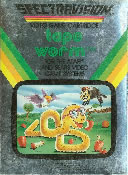
Tape Worm is an Action game, published by Spectravision, which was released in 1982.
Rating: Not rated yet Times Played: 2517 Released: 1982 |
ExedExes
2,055
|
Personal Best: N/A
|
All times are GMT -5. The time now is 06:05 PM.
|



